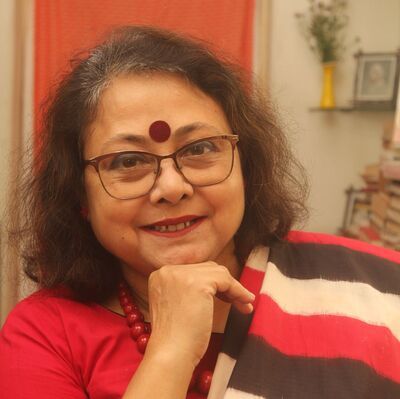
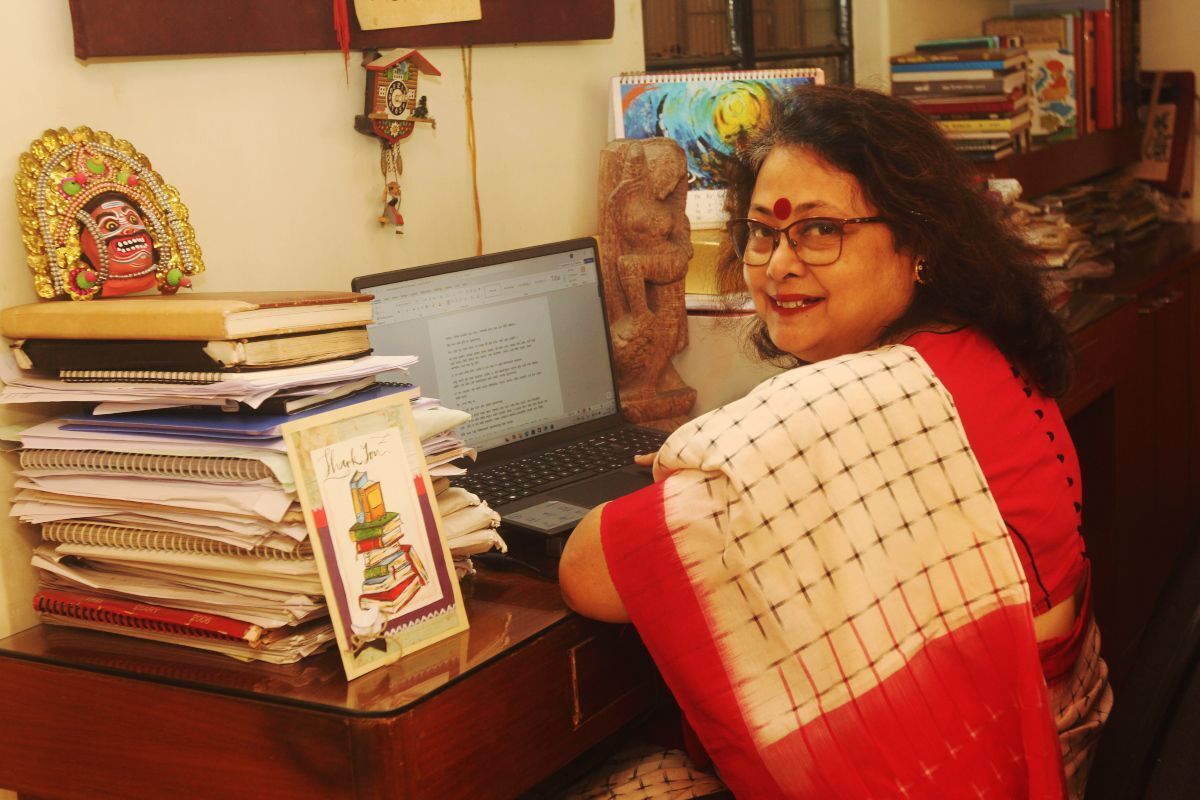
Dipanwita Roy, writer of children’s fiction, was born into a middle-class Bengali family and grew up in the industrial / coal mining town of Asansol, in the western part of West Bengal, India. After school, she did her graduation and post-graduation in Comparative Literature at Jadavpur University, Kolkata. She took up her career as a journalist, working as a reporter and a sub-editor in various magazines and a well-known daily newspaper. She moved on to the electronic media joining Eenadu Group in 1998, as a reporter for their Bengali channel `ETV Bangla’. Later, in 2005, she joined `ABP Ananda (formerly Star Ananda), a 24-hour Bengali news channel of the Ananda Bazar Patrika (ABP) Group, as an Asst Producer. She is currently holding the position of Sr. Producer in the same Company.
Dipanwita discovered her story-telling skills by making up bedtime stories for her daughter, Dishari, who was then a toddler. She found that her daughter was very fond of most of her stories and would want to hear them every night before drifting off to sleep. This gave Dipanwita the hope that her stories could touch a chord in the hearts of children. She put these stories down in writing using her skills honed in the course of her work as sub-editor and news producer. She shared her script with Mr. Priyabrata Deb of `Pratikshan’ publishing house. Mr. Deb, a connoisseur of art & literature, found the stories appealing and strongly encouraged Dipanwita to devote herself to writing for children. So it happened that her first book-a collection of stories for toddlers, titled `Chupti Kore Golpo Sono’ (hush-listen to the tales), was published by `Pratikshan’ in 2008. This was followed by Dithir Dupur (Dithi’s afternoons)-a collection for slightly older, school going children, brought out by the same publisher. Dipanwita now has 14 titles to her credit, brought out by leading publishers, including Ananda Publishers Pvt Ltd, Pratikshan, Shishu Sahitya Sansad, to name a few. Two of her works have been translated into English and published by the Children’s Book Trust. These, titled `Punti's Wedding’ and `Bukka, the naughty elephant’ have also won acclaim in South Korea and are being translated into Korean.
Dipanwita Roy’s works are marked by the simplicity of style and wide imagery as she conjures a magical world of children in close harmony with plants, animals, insects, birds and butterflies that are common to our daily lives. She writes in an urban setting, yet makes one yearn for nature and the warmth of community. She softly delivers her message of loving nature, protecting the environment and caring for a community life – living among and helping honest and hardworking ordinary people. Her crisp, direct and simple style helps in preventing her works from becoming preachy or didactic. Dipanwita writes straight from the heart and creates an ambience of freshness and innocence that finds an echo in children burdened by peer-pressure and alienation in modern, urban existence. She makes us long for our rural past and sows seeds of hope for the future.
Dipanwita broke fresh ground with her collection of short stories titled `M for Mystery’. Writing for an older readership, mainly adolescents, she makes her young readers stretch their imagination to have a feel on events, which cannot be explained by ordinary reason. A clerk working in a Govt Dept, leading a comfortable, but solitary life has but one passion, meandering about auction shops and gazing at antiques and articles put up for action. This innocent and prosaic pastime leads to the acquisition of a certain painting, which grows in size every day and gradually unfolds a story strangely familiar to the protagonist. Bit by bit, Dipanwita builds suspense, which reaches a climax with the picture showing a violent retribution and the protagonist vanishing without a trace. In another story, a young man, unemployed and poor, is desperate to get a job. With the aid of a friend he lands a job interview, but lacks a suitable dress to appear for it. His friend takes him to the flea market, where he buys a cheap, used coat and puts it on to appear for the interview. What happens next is unthinkable, as the young man acquires a demeanor of confidence and fluency of speech, quite unlike him and excels at the interview. Is it the coat and the spirit of the person who once used it, or the protagonist’s imagination, which stirs him to his success? One is left to wonder. Or take the case of the street hoodlum, who terrorizes innocents and aids unscrupulous businessmen in their illegal ventures. Every time he contemplates something evil, he gets a message from an unknown source deterring him. When he complies and does something good instead, he is rewarded by a smiley from the same mysterious source. Ultimately, the goon’s life changes for the better. The stories are neither yarns about the supernatural, nor the macabre, yet they urge readers to imagine things beyond the predictability of their daily existence.
It was, perhaps, a brilliant stroke of inspiration that drove Dipanwita to rekindle the memories of the iconic characters Bengali lore, Gupi and Bagha by writing on their offsprings. One will remember that in the film ‘Hirak Rajar Deshe’, the sequel to ‘Gupi Gyne, Bagha Byne’, a casual reference was made of Gupi and Bagha both fathering a son as sons-in-law to the kings of Shundi and Halla. Dipanwita caught this reference to build a story ‘titled ‘Gupi Baghar Polapan’, showing the princes grown into young adults and embarking on an adventure to find the king of ghosts (Bhooter Raja) in order to follow their fathers’ footsteps in seeing the world and delivering people from the clutches of evil. It makes for exciting reading and it is of no wonder that a leading figure in the Bengali film industry has acquired rights to make a film out of this story.
Dipanwita has established herself firmly in the genre of detective stories for the young adults. Her detective characters, be it the college-going duo Reno and Beto or the young professor, Diganta Deb, aka Dinu ;Tiktiki’ have become popular among the readers, both young and old. The narratives have the usual features of red herrings and twists that keep the readers guessing but the attention to detail and the adherence to strict reality make Dipanwita’s works distinct from run-of-the-mill whodunits.
It has been some years since Dipanwita has forayed into the realm of adult literature. Her maiden work was a collection of short stories titled “Swapne Bancha”, which mostly portrays the lives, struggles and aspirations of people from the lower classes, especially women. She then widened her horizon to write stories on romantic relationships, inner conflicts and complexities of modern life, mystery stories, even crime thrillers. Whatever the theme, Dipanwita’s writings always convey a spirit of positivity, her stories are firmly rooted in values of gender equality, empathy and a concern for nature and the environment in a contemporary setting. Her notable titles in the sphere of adult literature include ‘Sesh Banke Danriye’, ‘Tribhujer Choturtho Kon’, Katakuti Khela’, ;Mrityur Durotto Ekghanta’ and many others.
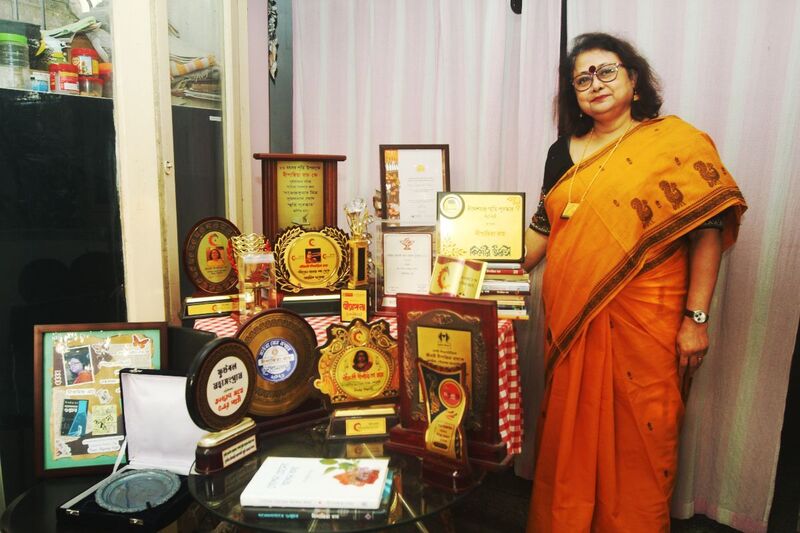
Dipanwita now has over fifty titles under her belt and her works have received wide acclaim. She has received many awards, the most significant being ‘Upendra Kishore Puraskar, 2017’ awarded by the Shishu Kishore Academy, Govt of West Bengal, ‘Gajendra Kumar Mitra – Promotho Nath Ghosh Smriti Puraskar, 2020’ from Miitra Ghosh Pvt Ltd.. and ‘Dinesh Chandra Chattopadhyay Smriti Puraskar, 2024 from Patra Bharati (the last two being the leading publishers of Bengali literature). The latest and the country’s highest literary award for children’s literature came to Dipanwita in the form of `Bal Sahitya Puraskar, 2024’, awarded by the Sahitya Akademi, New Delhi. There are many more awards that have come in Dipanwita’s way from smaller publishers as well as reputed literary magazines. These have established Dipanwita firmly among the notable writers of contemporary Bengal.
Dipanwita lives in the southern parts of Kolkata with her family. Her interests, other than her writing and her profession, lie in photography, travel, films and the theatre.